好日

Kōjitsu

Inspired by 日日是好日

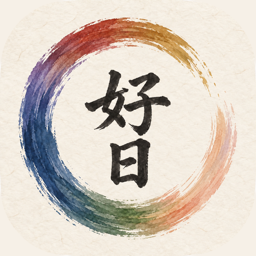
The Kōjitsu ensō: a painted circle, open on the right, in the colours of the six areas of life, with 好日 in the centre.

Every day is whole.

Kōjitsu shows you what your life is made of – without streaks, without a score and without daily perfection.

Not in the stores yet – Kōjitsu is currently in closed beta.

One day

A single day

A good day doesn’t have to be balanced.

The circle is complete before you enter anything. What you enter doesn’t change its worth, only its colour.

A day on the bike

Today: movement and rest.

  • Nourish & Enjoy at the edge
  • Movement at the centre
  • Interests & Growth
  • Rest & Recovery clearly
  • Connection
  • What mattered today at the edge

Four very different days. The colours change, the circle stays complete.

Six areas

Ingredients of a day, not a checklist.

None of them has to appear on any given day. One day may be shaped almost entirely by friends, another by sport, the piano or simply rest.

Nourish & Enjoy

Nourish · Enjoy · Moderation

Breakfast, lunch, dinner, snacks – and water, coffee, alcohol. Eating and drinking are one area, because nobody has dinner without something to drink. The question isn’t “How did it taste?” but “How good was it for you?”

Kaki · persimmon

Movement

Doing your body some good.

Workouts, steps, active calories – from Apple Health, without typing. Movement only counts from your own threshold: a few minutes don’t make a day that was shaped by movement.

Koke · moss
Interests & Growth

Curiosity · Learning · Step by step

Hobbies and rituals, learning with minutes and a sentence, and plans from the Apple Reminders lists you share. The number of completed tasks never colours the day – as soon as a number can go up, you start making it go up.

Ai · indigo
Rest & Recovery

Sleep · Pause · Breathe

Sleep and three quiet forms: just sitting, breath, mindful moments. For these there is a small timer that can do only one thing: end. No guided programme, no voice, no statistics about your practice.

Fuji · wisteria
Connection

Time with people who are good for you.

Family, time as a couple, intimacy, friends – four equal kinds, each with its own scope. Each can be switched off and then disappears completely, including from the ensō and all reviews.

Beni · warm red
What mattered today

Sometimes it’s the little things.

“What else mattered today?” Free text, in your own words. Not the sixth item of a score, but a way to step outside the grid.

Kincha · gold
Zooming out

The further you zoom out, the clearer your rhythm becomes.

Within a day, balance doesn’t matter. A week may be one-sided. Months and years show whether areas are missing or dominating for good.

A day is a moment. A week is a pattern.

Two days without an entry aren’t bad days. They are days Kōjitsu knows nothing about.

Some weeks are allowed to be one-sided.

A month of mini ensōs. Gaps stay gaps – they never look like “did nothing”.

A life is made of many different wholes.

Twelve months. Only here is it worth asking about measure.

Jan
Feb
Mar
Apr
May
June
July
Aug
Sept
Oct
Nov
Dec

And only now, the bars.

What’s measured: on how many recorded days did this area clearly appear? Nothing adds up to 100 %. More friends doesn’t push movement down.

Nourish 21 days
Movement 15 days
Interests 9 days
Rest 18 days
Connection 11 days
Moments 6 days

24 recorded days. Days without entries don’t count towards the denominator.

Weekly review

Notice. Place. Take along.

Two to five minutes at the end of a week. No performance review, no targets, no plan with numbers.

What shaped this week?

Example answerPretty sport-heavy – but I was on holiday, so that fits.

Which one-sidedness was deliberate?The evenings alone. I wanted them.

What was good for you?The long Sunday morning with nothing planned at all.

“Next week I’d like to give music a little more room again.”

This sentence quietly accompanies the next week – and may disappear without warning if life turns out differently.

Don’t optimise. Notice. Place. Keep living.

The attitude

Four focal lengths on the same life.

Yōjō and Chūdō are the depth of Kōjitsu, not competing ideas. Think of them as successive focal lengths.

Kōjitsu – The whole day

日日是好日 · “Every day is a good day”

In one of the best-known collections of Zen, master Yunmen answers his own question about the coming fifteen days with this sentence. It is not a verdict on how pleasant, healthy or productive a day was. The day is good because it is this day – not because it met enough criteria.

How do I look at this day?

Yōjō – What we tend

養生 · “nourishing life”

The best-known book of this tradition, Kaibara Ekiken’s Yōjōkun, appeared in 1713. It isn’t about peak performance but about everyday life – and about how a plant isn’t tended in a single day, but because you keep coming back to it. That’s why Kōjitsu rewards returning, not being uninterrupted.

Why is it worth paying attention to different areas of life?

Chūdō – Measure, not maximisation

中道 · “the middle way”

Chūdō doesn’t mean “spread six areas evenly”. It means that too little of something is an extreme as well. That’s why Kōjitsu doesn’t judge balance on a Tuesday, but in the rhythm of weeks, months and years – and describes where the weight lies before evaluating it.

How do I deal with emphases and extremes over longer periods?

Ensō – Complete, not perfect

円相 · “circle form”

An ensō is a circle drawn in a single brushstroke, one of the best-known motifs of Zen art. It often stays open, the line is irregular, dry in one place and heavy with ink in another. The brush isn’t corrected, and the circle has no single binding meaning.

In Kōjitsu it is your day: open on the right, complete from the morning on – the areas only give it colour.

What does this circle mean to you?

The difference

The opponent isn’t laziness.

It’s the idea that every single day should be even, productive and optimised.

Typical tracker
Kōjitsu
“What did you get done today?”
“What made your day?”
Completeness has to be earned
Complete from the start
A streak that can break
Rhythm and returning
Score, percentages, rings
Patterns and emphases
daily optimum
long-term measure
deviation = problem
deviation = context, first of all
Red when it was too much
counted, and you add the occasion
gap = setback
gap = a day nothing is known about
“Goal reached” / “not today”
“Today: movement and people.”
A subscription that keeps running
buy once, keep it

No streak that can break

Streaks work – until the day they break. Many people know what comes next: you don’t start again because the number is gone. So Kōjitsu counts how often something came back, not how long it ran without interruption. That’s why its milestones are called Returning and Tending, not “30 days in a row”.

No number that’s meant to rise

As soon as a number can go up, you start making it go up – ticking off trivia because it counts and putting off the hard things. That’s why the number of completed plans never colours the day, and two hours of stillness don’t make the area “more” than half an hour.

No red for drinking

Alcohol is counted neutrally; the amount makes a day neither more colourful nor worse. If the week goes beyond your own measure, Kōjitsu asks about the occasion with the next glass – without a warning colour. In numbers, a wedding looks like five lonely evenings; in your own words it doesn’t.

No gap that counts against you

Three weeks without an entry trigger nothing: no nudge, no broken chain, no “Welcome back, let’s get going again!”. Unrecorded days don’t count in any review – neither in the numerator nor the denominator. Life happens without an app, too.

Otherwise, at some point in the evening you stop looking at the day and start looking at the day’s balance sheet.

Kōjitsu has no 4-out-of-7, no streak, no score, no percentages, no life-balance value and no “goal reached” – not out of modesty, but because all of that contradicts the core idea.

In the app

Log, zoom out, look back.

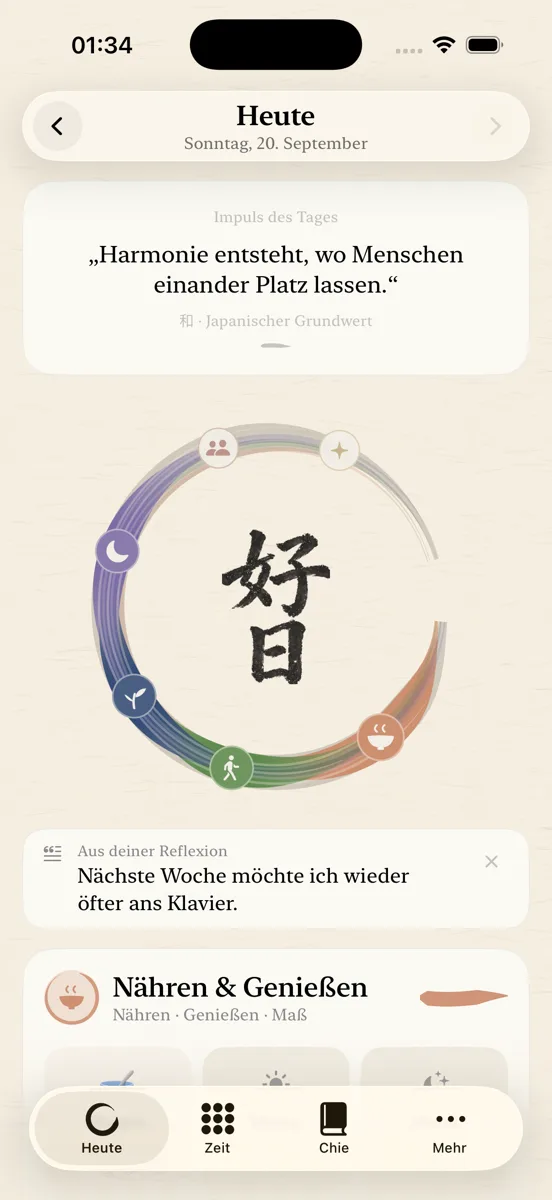
Today puts the daily prompt, the ensō and all six areas on one scrolling page. Time zooms from the week through month and year to your entire history and includes the weekly review. Perspectives gathers the learning journey, milestones and prompts.

The Today page: the daily prompt, below it the large ensō with the symbols of the areas.
Today · Prompt, ensō and all areas on one page
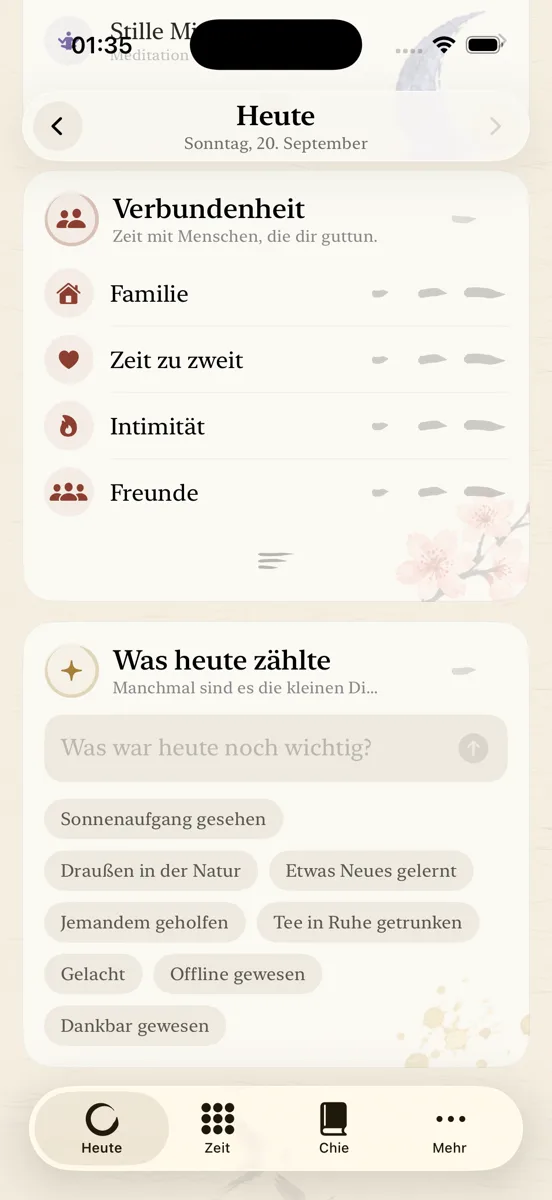
The Connection and What mattered today cards with brushstrokes for the scope.
Logging · Tap instead of forms, notes in handwriting
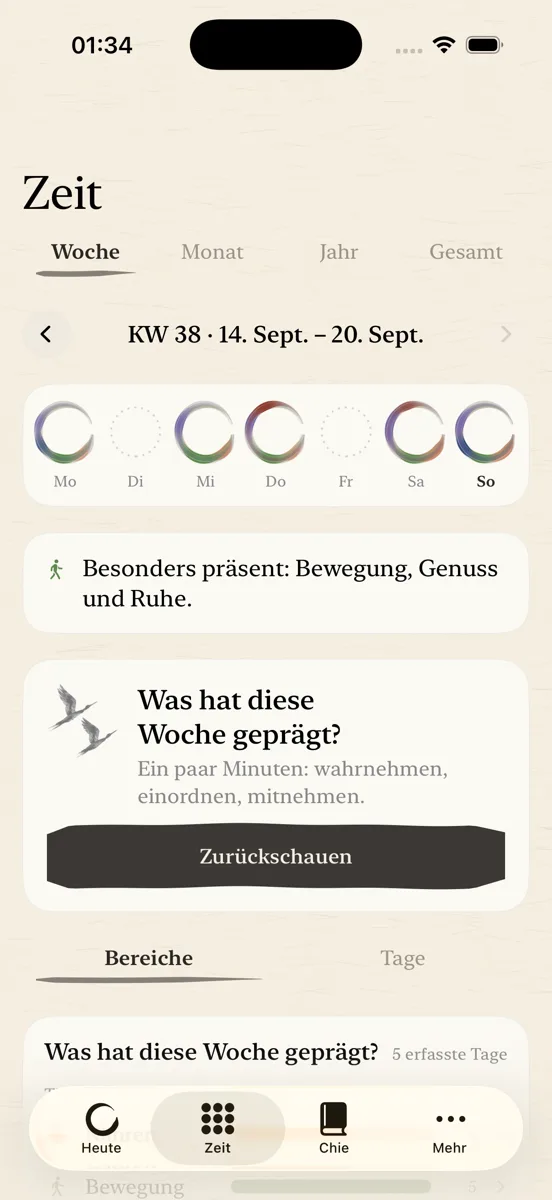
The week view: seven small ensōs, a descriptive sentence and the weekly review.
Week · Seven day ensōs, emphases, weekly review
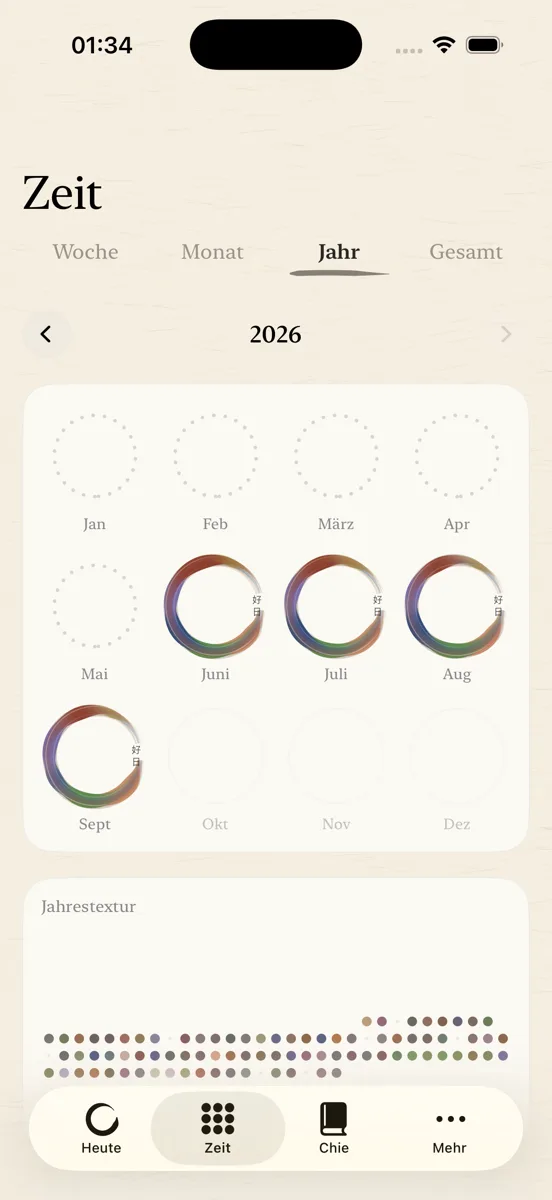
The year view: twelve month ensōs and the year texture below.
Year · Twelve month ensōs and the year texture
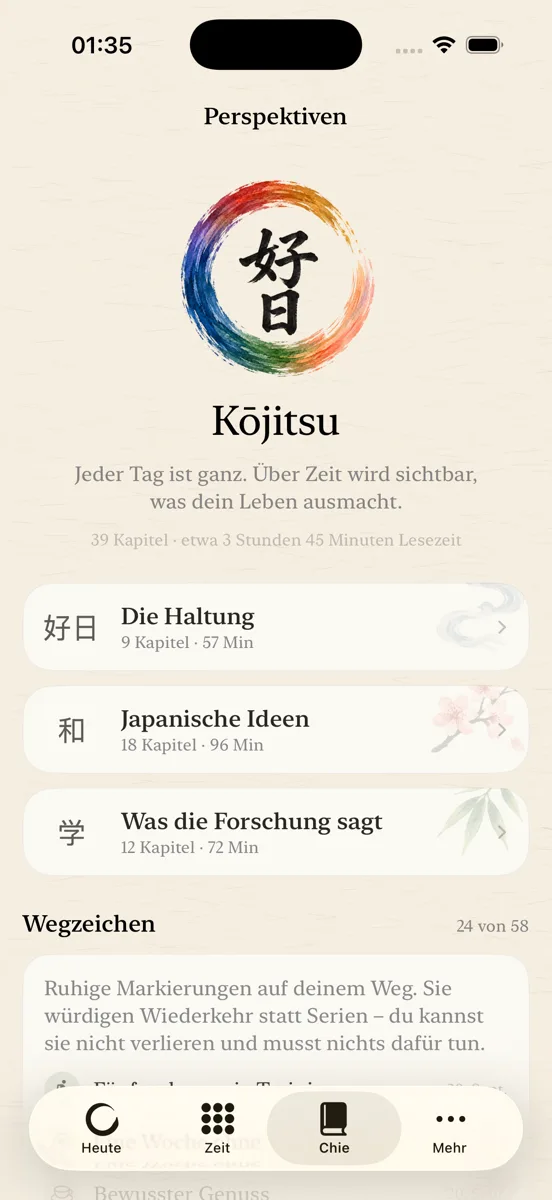
Perspectives: the three paths of the learning journey and the milestones.
Perspectives · 39 chapters, 58 milestones, over 100 prompts

Movement and sleep come from Apple Health, plans from the Reminders lists you share. Plus: Apple Watch for quick logging, widgets for day and week, and the day’s ensō as a Live Activity on the lock screen. The screenshots show the German app.

The learning journey

Read on, if you like.

39 chapters, a good three and a half hours. No quiz, no XP, no unlock order – not a course you have to finish.

The attitude

Kōjitsu, Yōjō, Chūdō, Ensō, rhythm, reflection, your own measure, gaps and returning.

9 chapters · 57 min

Japanese ideas

Where the terms come from, what they mean in the original – and where Kōjitsu goes its own way.

18 chapters · 96 min

What research says

Movement, sleep, connection, food, alcohol, habits – with sources and limits.

12 chapters · 72 min

Price

The day is free. Time is the value.

No subscription. Not because a subscription would be bad business, but because it doesn’t fit the attitude.

Kōjitsu

Free. A real app.

  • Today in full, all six areas
  • Daily ensō, your own words
  • The last few days and the current week
  • One sample weekly review
  • The core idea of Kōjitsu as the first chapter
  • Data export – always

Kōjitsu Lifetime

Buy once. Keep it.

  • Your complete history
  • Week, month, year and all time
  • Detailed rhythm views, long-term patterns
  • Weekly, later monthly and yearly reflection
  • The complete learning journey
  • All milestones

No subscription. No automatic renewal.

Areas of life and data export are never behind the paywall. If you say “your life belongs to you”, you don’t sell the export.

Your data stays with you

No required account, no sign-up. Kōjitsu stores everything locally on your device first; if you like, it syncs via your own iCloud. There are no servers of our own, no advertising IDs and no analytics SDKs. You can export at any time. Apple Health adds movement and sleep, but is never a requirement.

Details in the privacy policy (in German).

Every day is whole.

Not every day has to be balanced. Over time, your life can be.

Currently in beta

Kōjitsu isn’t in the stores yet. The app is running as a closed test – on iPhone via TestFlight, on Android via Google Play.

If you’d like to join, drop me a short note saying which device you use. I’ll add you and let you know as soon as the app is public.

For iPhone and Apple Watch. The app is currently in German only. Dark Mode, Dynamic Type and VoiceOver. The Android version is part of the same test.

Care and limits

Kōjitsu is inspired by Zen, Yōjō, Chūdō and Ensō and does not digitise an authentic teaching. Where the app goes its own way – for example in the colour logic of the ensō – the chapters say so explicitly.

Kōjitsu is scientifically informed life reflection, but not a validated score and not a medical application. There is no scientific basis for a universal, even distribution of the areas of life. If you sleep badly or feel exhausted for a long time, you won’t find the answer here – that belongs in other hands.